One Source of Truth for UTMs: Keeping a Team Consistent
There is a report every growing team opens exactly once before the cold sweat sets in. It is the traffic source list in Google Analytics, and there they are, lined up like mugshots: facebook, Facebook, fb, FB-Ads, and facebook.com. Five separate rows. Every one of them a real campaign built by a real person doing their honest best. And together they have quietly hacked one channel into five pieces, so now nobody in the building can say with a straight face what Facebook actually did last quarter.
This is not a discipline problem. Nobody woke up wanting to torch the reports. It is a missing source of truth, and when several people build tags with no shared definition of the right values, drift is not a risk, it is a law of nature. Here is how to fix it without appointing yourself sheriff of the naming police.
Why team tags drift into the swamp
No conspiracy here, just the usual small human failures piling up:
- Tribal knowledge.The convention lives in one person's skull, or in a Slack message that scrolled into the abyss eight months ago.
- Copy-paste archaeology. People dig up an old link and edit it, inheriting whatever disease it was already carrying.
- Honest disagreement. Is it
newsletteroremail? Both are defensible, so two reasonable people pick two different answers and both feel righteous. - New hires. Every fresh marketer invents a private system until somebody stops them, and usually nobody does.
The thread running through all of it is the same: tagging leans on memory and guesswork. A source of truth takes both out behind the barn.
What a source of truth actually is
It is not a document. Documents are where good conventions crawl off to die. A real source of truth has three moving parts:
- An approved list of values. The exact sources and mediums your team is allowed to use, written in one place and only one place.
- A naming format. One pattern for campaign names, like
year_quarter_initiative, so2026_q1_launchis the only spelling that counts as correct. - A way to pick, not type. This is the part that keeps the whole thing alive. If people select from a dropdown of approved values, they physically cannot misspell them.
That last one is the entire ballgame. A convention you have to remember will be broken by Tuesday. A convention wired into the tool people already use will not.
Rolling it out without starting a war
- Agree on the lists. Get the team in a room for thirty minutes and settle the sources and mediums like adults. Keep the medium list short. Six or seven values cover nearly the whole world.
- Pick one naming format and write one example. People copy a good example far more faithfully than they follow a rule.
- Put the lists where the links are actually born. If the approved values are dropdowns in the builder, adoption happens on its own. If they are in a wiki, adoption is a prayer.
- Give it one owner. One person or a small crew owns the lists and blesses additions. Everyone else builds from them. Ownership without a bottleneck.
- Review once a month. Open the source and medium report and read it like a police scanner. A brand new variant of an existing channel is your first sign somebody tagged off the reservation. Fix it while it is one row, not fifty.
The payoff, and it is a real one
When everyone tags from the same list, a few things happen at once and all of them feel like relief. Your channel reports collapse back to one honest row per channel. New hires are useful on day one because they pick from a menu instead of guessing in the dark. And you never again have to open the quarterly meeting with "wait, which of these five Facebook rows is the real one?"
How UTMBuilder hands you one source of truth
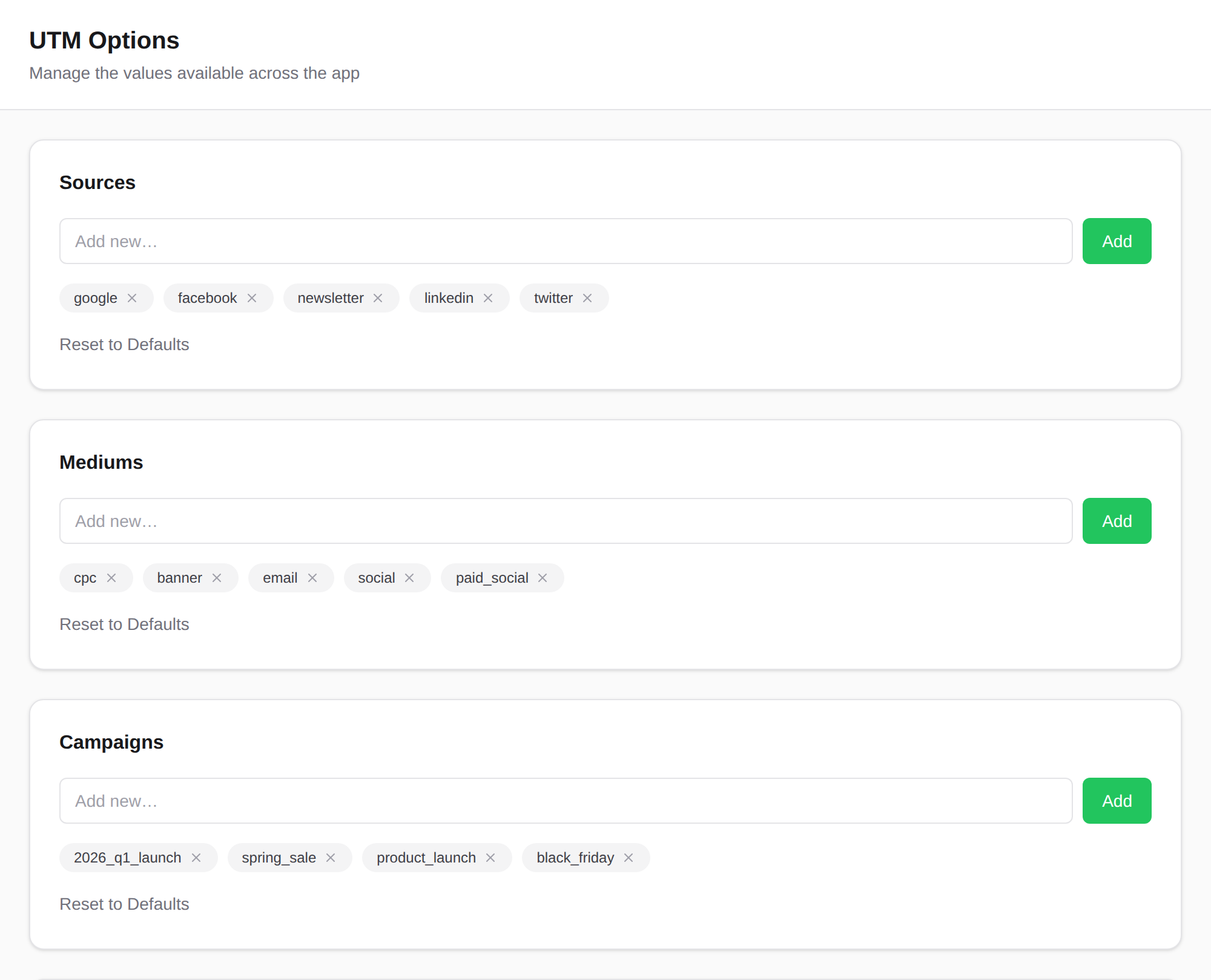
This is the precise mess the UTM Options and Campaign Creator features were built to end. You set your approved sources and mediums once, and every builder in the app, single or bulk, drinks from that same well. Campaign names come out in one format without anyone thinking about it. New marketers pick from dropdowns instead of inventing their own dialect, and every link the team builds gets saved into shared projects so nothing wanders off. The standard stops being a document and becomes the path of least resistance, which is the only kind of standard anyone ever actually follows.
Build clean UTM links in seconds
Set your sources, mediums, and campaign names once, then generate consistent, correctly encoded links, one at a time or in bulk.
Start building freeFrequently asked questions
- What is a UTM source of truth?
- One agreed place that defines the exact sources, mediums, and naming format everyone uses, so two people tagging the same channel produce identical tags. It works best when those values are dropdowns people pick from, not a document they have to remember.
- How do I get my team to follow a UTM convention?
- Make it easier to follow than to ignore. Give people a dropdown of approved sources and mediums instead of a rules document, so they pick correct values rather than typing and misspelling them.
- Who should own UTM naming on a team?
- One person or a small group owns the approved lists and the naming format and approves additions. Everyone else builds from that list. It is ownership without turning that person into a bottleneck.
- How often should we review our UTMs?
- A quick monthly look at your source and medium report catches drift early. A brand new variant of an existing channel is the signal that someone tagged outside the standard, and it is far easier to fix when it is one row instead of fifty.